Jam Sessions: How to Improvise With a Band
Jamming is how songs are born. Now you can jam any time, with a full band that listens.
An AI jam session is exactly what it sounds like: you play your instrument, and an AI band plays along in real time. No scheduling. No other musicians needed. No backing tracks on loop. BandM8 makes this possible through Music-to-Music AI that listens to your live performance and generates complementary parts from drums, bass, keys, and other instruments in the moment. The result is collaborative AI music that feels like a conversation, not a pre-programmed response. You lead. The AI follows. And the music that comes out of the session is something neither of you would have made alone.
Jamming has always been the most natural way musicians discover new ideas. A riff turns into a groove. A groove turns into a song. The problem is that jamming requires a band, and most musicians do not have one available at 2 AM when inspiration hits. BandM8 solves that by putting an AI bandmate in your studio, ready to play whenever you are.
This article covers how AI jam sessions work, why they produce creative results that solo practice cannot, and how to turn spontaneous jams into finished songs. If you have ever wished you could call up a band at a moment's notice, this is the workflow that makes it real.
How an AI Jam Session Works in BandM8
You open BandM8 and start playing. It does not matter what instrument you use. Guitar, keyboard, bass, voice, or even a MIDI controller tapping out a rhythm. The platform's real-time music generation engine detects your key, tempo, and rhythmic feel within seconds. Then it begins generating parts. A drummer locks into your groove. A bass player follows your chord changes. Keys fill out the harmonic space. Everything responds to what you are doing, so when you change direction, the band changes with you.
This is not a static backing track. If you shift from a verse feel to a chorus feel, the AI adjusts its intensity. If you drop out entirely, the band can hold the groove or pull back. If you introduce a new chord, the harmonic response updates across every instrument. The AI is listening, not just playing.
The experience of playing with BandM8's AI band is qualitatively different from playing along with a recording or a loop. A recording does not know you are there. A loop does not respond to your choices. BandM8's AI players are reacting to your performance in real time, which means the music evolves as you explore. You might start with a simple two-chord vamp and gradually introduce complexity. The AI tracks that progression, adding complexity to its own parts as you add complexity to yours. This co-evolution is what makes the session feel alive rather than mechanical.
The technical infrastructure that makes this possible involves low-latency audio-to-MIDI conversion, real-time harmonic analysis, and coordinated multi-instrument generation. From the musician's perspective, none of that matters. What matters is that you play, and a band responds. The technology disappears behind the musical experience, which is exactly where it should be.
Why Jamming With AI Unlocks New Ideas
Every musician has experienced creative blocks. You play the same patterns, reach for the same chord progressions, and end up in familiar territory. Jamming with other musicians breaks those patterns because other players introduce ideas you would not have thought of. An AI jam partner does the same thing. BandM8's AI music agent generates parts based on your input but filtered through musical knowledge that spans genres, styles, and approaches you might not default to.
Play a simple folk chord progression, and BandM8 might respond with a rhythm section that pushes it toward something more driving. Lay down a heavy riff, and the AI might add a melodic counter-line that opens up space you did not know was there. These surprises are the entire point of jamming. The AI does not just accompany you. It contributes ideas that push your music in directions you would not have explored alone.
There is a specific creative mechanism at work here that cognitive scientists call "productive constraint." When you play alone, you have infinite options. Paradoxically, this freedom often leads to creative paralysis or habitual patterns. When you play with a band, the other musicians' choices constrain your options in productive ways. The drummer's groove suggests certain rhythmic approaches. The bass player's line implies a harmonic direction. These constraints focus your creativity and push you toward solutions you would not have found in open-ended solo exploration. BandM8's AI players create the same productive constraints. Their musical choices shape the space you play in, and that shaping generates ideas.
The AI also introduces a quality that human jam partners do not always provide: inexhaustible patience. A human bandmate might lose interest after the fifth take of a groove. They might push to move on before you have fully explored an idea. The AI keeps playing for as long as you keep exploring. This patience means you can sit with an idea, turn it over, try variations, and gradually refine it without social pressure to hurry up. Some of the best musical discoveries happen in the quiet space between the fifth and the fifteenth iteration of an idea, and the AI gives you room to reach those iterations.
From Jam to Song: Capturing What Works
The best songs start as accidents in a jam. BandM8 makes sure those accidents get recorded.
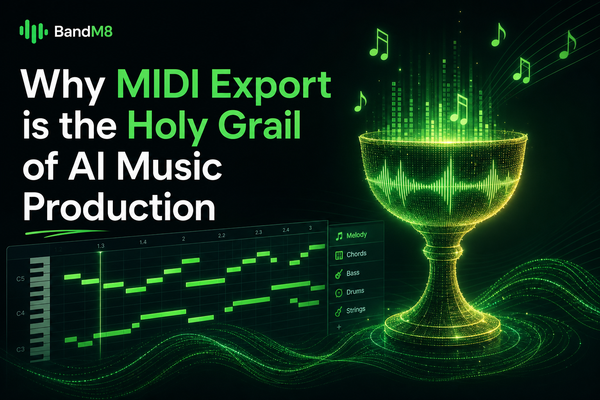
One of the biggest frustrations in live jamming is losing great moments. You stumble onto a brilliant groove, but nobody hit record. With BandM8, every AI jam session produces editable MIDI output. The parts the AI generates are captured as multi-track MIDI that you can review, edit, and export into your DAW after the session. The magic moments are preserved in a format you can work with.
This transforms the jam from a purely spontaneous event into the first stage of a production workflow. Jam freely. Find the moments that resonate. Pull those MIDI parts into your project and build around them. The improvisation feeds the composition, and nothing gets lost in the process.
The MIDI output is particularly valuable for the transition from jam to song because MIDI is infinitely malleable. A groove that worked in the jam might need a slightly different bass line to work as a verse. A chord progression that felt great in improvisation might need one chord changed to set up a chorus properly. Because everything is MIDI, these adjustments take seconds. You are not re-recording or re-generating. You are refining raw material that already has the energy and feel of a live performance baked in.
Many prolific songwriters describe their process as a funnel. Generate many ideas, capture everything, then filter and refine the best ones. AI jam sessions accelerate the widest part of that funnel. In a one-hour jam, you might generate dozens of grooves, progressions, and arrangement ideas. From those dozens, maybe three or four have the spark of a real song. Those three or four become the projects you invest deeper production time in. Without the jam, you might never have found them.
AI Jam Sessions for Practice and Skill Building
Jamming with AI is not only a songwriting tool. It is also one of the most effective ways to practice. Playing along with a responsive band forces you to listen, stay in time, and react to what is happening around you. These are skills that playing alone with a metronome cannot develop. Music education has long recognized the value of ensemble playing, but access to ensembles is limited by geography, scheduling, and cost. BandM8 gives any musician a band to practice with on demand.
For guitarists working on their rhythm playing, an AI band provides immediate feedback. If your time drifts, you hear it because the band is locked in and you are not. If your dynamics are inconsistent, the AI's response highlights the inconsistency. These are things a metronome cannot show you because a metronome does not react to what you play. An AI band does, and the reaction teaches you things about your playing that you cannot learn any other way.
Improvisation practice benefits even more directly. A jazz musician working on soloing needs chord changes, a rhythm section, and a harmonic context to improvise against. A blues guitarist needs a shuffle groove and a walking bass line. A rock keyboardist needs a driving drum pattern and a distorted guitar riff. BandM8 provides all of these contexts on demand, in any key, at any tempo. The practice environment matches what you need to work on, not what a pre-recorded backing track happens to offer.
Structuring an AI Jam Session for Maximum Results
While spontaneity is the essence of jamming, a little structure can dramatically improve the quality and usability of what comes out of a session. One effective approach is to start each jam with a single constraint: a key, a tempo, a mood, or a rhythmic pattern. The constraint gives the session a starting point without predetermining where it goes. You play a groove in A minor at 90 BPM, and everything the AI generates aligns with that foundation. From there, you explore freely within those parameters.
Another productive structure is to treat the jam as an arrangement exploration. Play a song idea you are working on and let BandM8 generate different arrangement options by changing your performance energy. Play the verse quietly and see what the AI does. Then play the same chords with more intensity and see how the arrangement changes. Then strip back to just a rhythmic pattern and listen to how the AI fills the harmonic space. Each variation produces a different arrangement sketch, and comparing them helps you decide what the song needs.
Recording-focused jams benefit from a simple protocol: play for three to five minutes, then review the MIDI output, flag the best moments, and either develop them further or start a new exploration. This iterative approach prevents the jam from wandering aimlessly while still allowing enough freedom for unexpected discoveries. The review step is quick because you are scanning MIDI data, not listening through minutes of audio. You can see at a glance where the interesting harmonic movement happened, where the groove was tightest, and where the energy peaked.
Genre Exploration Through AI Jamming
One of the least obvious but most valuable uses of AI jam sessions is genre exploration. Every musician has genres they are curious about but have never seriously explored because they lack the backing band to make it work. A rock guitarist curious about jazz needs a jazz rhythm section to practice over. A hip-hop producer curious about Latin music needs congas, timbales, and a montuno piano pattern. A singer-songwriter curious about electronic music needs a drum machine feel and synth textures. BandM8 provides all of these contexts on demand.
The AI's genre response is driven by your musical input, not by a genre selector. If you play a swing rhythm, the AI responds with jazz-influenced parts. If you play straight eighth notes with a driving feel, it responds with rock or pop sensibilities. If you play a syncopated rhythm with chromatic bass movement, it might pull toward funk or R&B. This input-driven genre awareness means you do not need to know the theory behind a genre to explore it. You just need to play in a way that suggests it, and the AI fills in the stylistic details.
For musicians who are expanding their creative range, this is transformative. Genre crossover is where some of the most interesting music happens, and BandM8's AI jam sessions make crossover experimentation risk-free. You are not asking a real drummer to learn a genre they are unfamiliar with. You are not spending money on session musicians to test an idea you might not use. You are exploring freely with an AI band that follows you wherever you go musically, and keeping whatever works.
The Social and Creative Value of AI Jamming
There is a concern, worth addressing directly, that AI jam sessions might replace human musical interaction. They do not, and they should not. Playing music with AI is not a replacement for playing with humans. It is a way to play more often, explore more freely, and arrive at your next human jam session with better ideas and sharper instincts.
Human jam sessions have qualities that AI cannot replicate: the social energy of being in a room together, the non-verbal communication between musicians who know each other's tendencies, the emotional resonance of shared creative experience. These are irreplaceable. What AI jam sessions offer is availability and patience. The AI band is there when your human bandmates are not. It lets you explore without judgment, experiment without wasting anyone's time, and develop ideas to a point where they are ready to share with other musicians.
The musicians who get the most out of AI jamming are the ones who use it as a complement to human collaboration, not a substitute for it. They jam with BandM8 to generate ideas, sketch arrangements, and sharpen their playing. Then they bring the best material to rehearsal with their human band, where the music takes on the dimension and depth that only human interaction can provide. BandM8 builds the band that is always ready when you are, so that when your real band gets together, you have something extraordinary to bring to the room.
Play something. BandM8 builds the band.
Try BandM8 free and hear what happens when AI plays with you.
Get Started