How to Find Bandmates Online in 2026
Finding reliable musicians has always been hard. In 2026, you have options that did not exist before.
Finding bandmates online remains one of the most frustrating experiences in music. Platforms like BandMix, Vampr, and Reddit communities promise connections but deliver inconsistent results: flaky responses, mismatched skill levels, geographic limitations, and creative disagreements that surface after weeks of wasted time. BandM8 introduces an alternative that bypasses the matchmaking problem entirely. Instead of searching for musicians who match your style, schedule, and commitment level, you play your music and an AI bandmate fills in the rest of the band. The result is collaborative AI music that sounds like a full ensemble and is available whenever you want to play.
This does not mean human collaboration is dead. Playing with other musicians remains one of the most rewarding experiences in music. But the reality for most solo musicians is that reliable bandmates are hard to find, harder to keep, and impossible to summon at midnight when inspiration strikes.
This article covers the full landscape of options for finding musical collaborators in 2026, from traditional platforms to AI alternatives, and helps you decide which approach fits your needs and creative goals.
The Traditional Bandmate Search in 2026
The options for finding musicians to collaborate with have not changed much in the last decade. BandMix charges a subscription for messaging. Vampr operates like a dating app for musicians, which works in dense urban areas but falls apart in smaller cities. Reddit communities like r/BedroomBands and r/MusicInTheMaking connect people for remote collaboration, but the follow-through rate is low. Craigslist still exists for local searches, with all the unpredictability that implies.
The core problem with every matchmaking platform is dependency. You need another person to show up, be prepared, share your creative vision, and stay committed. Any one of those requirements can fail. For independent artists trying to build momentum, waiting on unreliable collaborators stalls progress at the worst possible time.
The frustration is compounded by the mismatch between expectations and reality. You post a listing describing your musical vision, your influences, and the kind of band you want to build. The responses you get range from musicians with completely different goals to people who seemed interested but ghost after two messages. Even when you find someone who seems like a fit, the first rehearsal often reveals incompatibilities that the text-based matching process could not surface. Musical chemistry is something you can only evaluate by playing together, and getting to that point costs time and emotional investment that you cannot get back when it does not work out.
Geographic constraints add another layer of difficulty. If you live in a major city, the pool of potential collaborators is large but so is the competition for their time. If you live in a smaller town or rural area, the pool may be so small that finding a compatible musician in your area is statistically unlikely. Remote collaboration tools have partially addressed this, but they introduce their own set of challenges around latency, workflow compatibility, and the loss of in-person creative energy.
Online Music Collaboration Platforms Worth Trying
Online music collaboration has improved with tools like Splice, Soundtrap, and BandLab, which let musicians share projects and record parts asynchronously. These platforms solve the geography problem but not the reliability problem. You can start a project with a collaborator in another country, but you still need them to deliver their parts on time, at a quality level that matches yours, with a creative direction that aligns with your vision.
For some musicians, asynchronous collaboration works well. Producers who need a specific vocal or guitar part can post a project and wait for submissions. But for musicians who want the energy and spontaneity of playing with a band, async collaboration misses the point. The magic of a band is not file sharing. It is playing together and responding to each other in real time.
The async model also creates a creative bottleneck that many musicians do not anticipate. You send your guitar part to a collaborator for drums. They take a week to send something back. You listen and realize it does not quite fit, so you send notes. Another week passes. The revision is better but still not right. By the time you have a drum part you are happy with, the creative energy that fueled the original idea has dissipated. Songs die in the gap between sending a part and receiving the response. The async workflow optimizes for convenience at the expense of creative momentum.
There are also platforms specifically designed for real-time remote jamming, where multiple musicians play simultaneously over the internet. These tools are impressive but limited by physics. Even with the fastest internet connections, audio latency between remote players creates a perceptible delay that makes tight ensemble playing difficult. The technology has improved, but it has not solved the fundamental constraint that data takes time to travel between locations. For styles that depend on locked-in rhythmic precision, real-time remote jamming still falls short of the in-person experience.
AI Bandmates: A New Option for Solo Musicians
The best bandmate is one who always shows up, always listens, and never argues about the setlist.
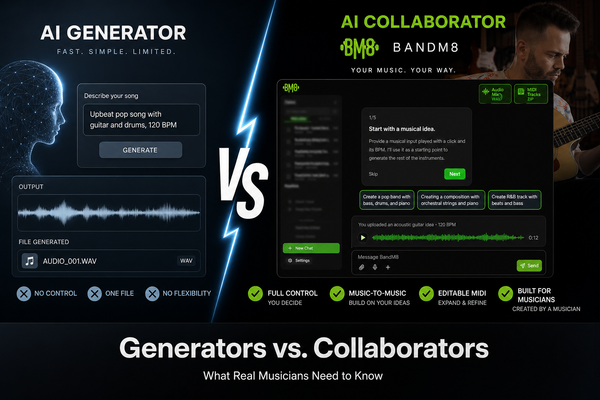
BandM8's Music-to-Music AI offers something no matchmaking platform can: a band that is available on demand, every time, with zero friction. You play guitar. BandM8 adds drums, bass, and keys that respond to your performance. You do not need to explain your vision, share reference tracks, or negotiate creative direction. The AI listens to what you play and responds musically. If you want to change direction, you just play something different.
This is not about replacing human musicians. It is about filling the gap between sessions with real people. Bedroom producers who cannot afford session players. Songwriters who hear a full arrangement but only play one instrument. Guitarists who want to practice with a full band feel. These are musicians who need collaborators more often than human logistics allow.
The AI bandmate also eliminates several sources of friction that plague human collaborations. There are no creative disagreements. The AI follows your lead. There are no scheduling conflicts. The AI is available whenever you are. There are no ego clashes. The AI does not need credit, recognition, or a share of the royalties. There are no communication breakdowns. You communicate through music, and the AI understands. These are not trivial advantages. For musicians who have lost months or years to dysfunctional band dynamics, they represent a fundamentally different creative experience.
The quality of the AI-generated parts has also reached a level where the output is musically useful, not just technically functional. BandM8's AI session players generate parts that have musical sensibility: appropriate note choices, dynamic variation, genre-aware rhythmic patterns, and structural awareness. These are not random notes that happen to be in the right key. They are musical ideas that a competent session player might contribute to a real rehearsal.
Using AI Bandmates Alongside Human Collaborators
The strongest creative workflow in 2026 combines both. Use BandM8 to develop ideas quickly, sketch out full arrangements, and test different directions for a song. Then bring the best ideas to your human collaborators with a clear vision and demo tracks already in place. The AI does not replace the conversation you have with your bandmates. It gives you better material to bring to that conversation.
Every part BandM8 generates is MIDI, so a human drummer can listen to the AI-generated drum part, take what works, and replace what does not. A bass player can use the AI bass line as a starting point and add their own feel. The AI accelerates the creative process without removing the human element.
This workflow also makes human rehearsals more productive. Instead of spending the first hour of a band practice trying to figure out what the song should sound like, everyone can listen to the BandM8 demo beforehand and arrive with a shared understanding of the arrangement. The rehearsal time gets spent playing, not explaining. The drummer already knows the general feel. The bass player already has a reference for the harmonic movement. The discussion shifts from "what should this sound like?" to "how do we make this sound even better?" That is a much more productive conversation.
For musicians who are between bands, AI bandmates also serve as a creative bridge. Losing a bandmate to a move, a schedule change, or a musical disagreement can stall a project for months while you search for a replacement. BandM8 keeps the music moving during those transitions. You do not have to stop writing, stop recording, or stop developing ideas just because your human band is incomplete. The AI fills the gap until the right person comes along, and when they do, you have a body of work to share with them rather than a collection of unfinished sketches.
The Psychology of Finding and Losing Bandmates
Finding bandmates is not just a logistical problem. It is an emotional one. Musicians invest deeply in collaborative relationships, and when those relationships fail, the impact goes beyond lost rehearsal time. The songwriter who spent months developing material with a collaborator who then disappeared feels betrayed. The guitarist who joined a band with high hopes only to discover irreconcilable creative differences feels disillusioned. The vocalist who cannot find a single compatible musician in their area feels isolated. These emotional costs are real, and they drive many musicians to stop looking for collaborators entirely.
The result is a large population of musicians who have given up on collaboration not because they do not want it, but because the search process has been too painful. They have been ghosted too many times. They have invested in relationships that went nowhere. They have compromised their creative vision to accommodate partners who ultimately did not work out. For these musicians, the idea of an AI bandmate is not a lesser alternative to human collaboration. It is a way to make music again without the emotional risk of another failed search.
BandM8 does not pretend to replicate the deep personal connection of a great band. What it does is remove the barriers that prevent musicians from making music. If the search for bandmates has stalled your creative output, BandM8 gets you playing again immediately. The music does not care whether the bass player is human or AI. It only cares that the bass line fits the song. And for a musician who has not heard their song with a full band in months or years, hearing that full arrangement for the first time through BandM8 can be a genuinely powerful creative experience.
Building a Portfolio as a Solo Artist With AI Support
For independent artists who are building a portfolio or catalog, the inability to find bandmates is not just frustrating. It is career-limiting. A singer-songwriter with ten unfinished demos and no produced tracks has nothing to show labels, sync licensing companies, or booking agents. A guitarist with great riffs but no full arrangements cannot create a compelling streaming profile. The gap between "I write songs" and "here are my songs, fully produced" is the gap that stops many independent music careers before they start.
BandM8 closes that gap by letting solo artists produce full-band recordings without a band. You can build a portfolio of finished tracks, each with professional-quality arrangements, and present yourself as a fully realized artist rather than a work in progress. The AI-generated parts are yours to use in any context: streaming releases, sync licensing submissions, live performance backing tracks, or demos for potential collaborators and labels.
The portfolio effect is cumulative. Every track you finish and release builds your catalog, grows your audience, and strengthens your position as an artist. Waiting for the perfect band before you start releasing music is a luxury most independent artists cannot afford. BandM8 lets you start now, build momentum, and attract human collaborators from a position of strength rather than desperation. When you have a catalog of produced music to share, finding bandmates becomes easier because they can hear what you sound like, not just what you describe.
Choosing the Right Collaboration Model
The decision between human collaboration, AI collaboration, and some combination of both depends on what you are trying to accomplish. If you are building a band for live performance, you need human musicians. AI cannot take the stage with you in the way a real band can. If you are writing and recording songs as a solo artist, AI bandmates may be all you need. If you are somewhere in between, using AI for development and humans for performance and final production is a practical approach that gives you the benefits of both.
BandM8 gives you a band when you need one and steps aside when your real band shows up. The platform is not trying to replace the experience of making music with other people. It is trying to make sure you can make music even when other people are not available. For the millions of musicians who have great ideas but no band to play them with, that is not a compromise. It is a breakthrough.
Play something. BandM8 builds the band.
Try BandM8 free and hear what happens when AI plays with you.
Get Started