Producer AI Tools: How Beatmakers Use AI in 2026
The producer AI landscape has exploded. Here is what actually matters for people making music.
Producer AI in 2026 covers a sprawling category of tools, from mastering plugins to stem splitters to full arrangement generators. For beatmakers and music producers, the challenge is no longer finding AI tools. It is finding the ones that fit a musician-first workflow. BandM8 occupies a specific position in this landscape: it is not a mastering tool, a mixing assistant, or a text-to-music generator. It is a Music-to-Music AI platform that generates full band arrangements from your live input, giving producers a collaborator instead of a shortcut.
The distinction matters because producers care about control. A tool that makes decisions for you might save time on one project but costs you creative ownership over time. A tool that responds to your musical ideas and gives you editable output respects the way bedroom producers actually work.
This guide maps the producer AI landscape, identifies where different tools fit in a production workflow, and explains why the collaboration model BandM8 pioneered matters more than any individual feature.
The Producer AI Landscape in 2026
AI tools for music production now touch every stage of the workflow. On the composition side, tools range from chord suggestion engines to full arrangement generators. On the production side, AI-powered mixing and mastering services can process a track in minutes. Stem separation tools like those from Moises and others use AI to isolate vocals, drums, and instruments from finished recordings. Sample-finding tools use AI to match sounds to your project's key and tempo.
Each of these tools solves a specific problem. But most of them operate on finished or near-finished material. They process audio you have already recorded, or they generate audio from parameters you set. Very few tools participate in the creative act itself. That gap is where BandM8 sits. It does not process your music after you make it. It plays with you while you make it.
The landscape can be roughly divided into four categories. Post-production tools handle mixing, mastering, and audio cleanup after the music is recorded. These include AI mastering services and intelligent EQ plugins. Extraction tools pull material from existing audio, like stem separation and audio-to-MIDI conversion. Generation tools create new musical content from parameters or prompts, including text-to-music platforms and loop generators. And collaboration tools play alongside you in real time, responding to your musical input. BandM8 is the defining platform in this fourth category.
Understanding which category a tool belongs to helps producers integrate it effectively. A producer might use extraction tools to pull a drum loop from a reference track, a collaboration tool like BandM8 to build an arrangement around their own playing, and a post-production tool to master the final mix. Each tool does something different, and the most effective producers in 2026 are the ones who understand how to chain them together into a workflow that serves their creative vision.
How Beatmakers Are Using BandM8 in Production
The typical BandM8 workflow for a producer starts with a core idea. A chord progression on a MIDI controller. A drum pattern tapped out on pads. A bass line played on a keyboard. BandM8's real-time music generation engine takes that input and builds the rest of the arrangement. The output is multi-track MIDI that drops directly into any DAW.
From there, the producer has total control. Keep the AI-generated drum pattern but reprogram the hi-hats. Use the bass line but pitch it down an octave. Scrap the keys and add a synth pad instead. Because everything is MIDI, nothing is permanent until you decide it is. The AI accelerates the sketch phase without constraining the final production.
Producers describe this workflow as a creative multiplier. Instead of starting with a blank project and building from zero, they start with a full arrangement that already has musical coherence and then sculpt it into the final production. The analogy to sculpture is apt. A sculptor does not start with nothing. They start with a block of material and remove what does not belong. BandM8 gives producers the block. The producer's skill, taste, and vision determine what the finished piece looks like.
The workflow also supports rapid iteration, which is critical for producers who work on multiple projects simultaneously. A hip-hop producer might generate three different arrangement options for the same chord progression in ten minutes, export the one that hits hardest, and move on. A pop producer might use BandM8 to test whether a verse works better with a sparse rhythm section or a full band arrangement. The speed of generation means creative decisions get made while the energy is high, not after the tedium of manual programming has drained it.
Producer AI That Respects Your Creative Process
The best producer AI does not make your beats for you. It helps you make more of them.
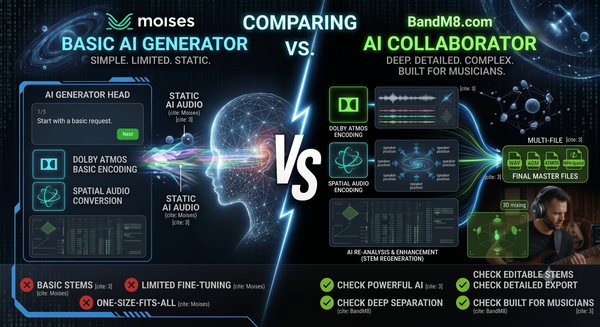
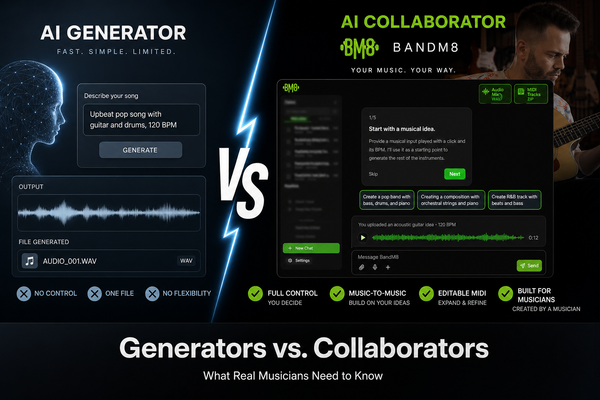
There is a meaningful difference between AI tools that generate music and AI tools that collaborate on music. A generator gives you a finished product based on a prompt. A collaborator gives you raw material based on your performance. For producers who take pride in their sound, the collaborative model is the only one that makes sense. Your beats should sound like you, not like a preset that anyone with the same tool could produce.
BandM8's MIDI-first AI architecture ensures that nothing is locked. Every note the AI generates is a suggestion, not a mandate. Producers who use BandM8 report that it changes how they start sessions. Instead of staring at an empty arrangement, they play an idea and immediately have a full band to react to. The first five minutes of a session become productive instead of empty.
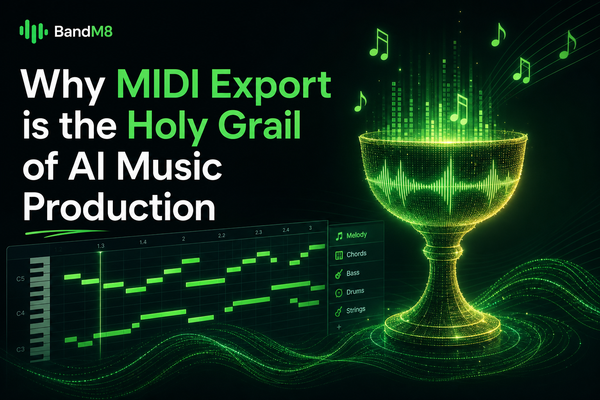
The creative respect that MIDI-first output represents cannot be overstated. When an AI tool outputs a finished audio file, it is implicitly saying, "This is the sound." When it outputs MIDI, it is saying, "This is the idea. You decide how it sounds." That difference maps directly to the producer's role. Producers are not consumers of finished content. They are architects of sonic experiences. MIDI respects that role. Rendered audio does not.
This is also why BandM8 avoids the "one-click beat" paradigm that some AI tools promote. A beat that takes one click to generate takes one click for everyone else too. There is no competitive advantage in a tool that produces the same output for every user. BandM8's output is unique every time because it starts with your unique musical input. Two producers playing the same chord progression will get different results because they play differently: different rhythmic feel, different dynamics, different voicings. The AI responds to these differences, which means the output carries the producer's fingerprint even before they begin editing.
Integrating AI Tools Into an Existing Workflow
Adopting producer AI tools does not require rebuilding your entire workflow. The most practical approach is to identify the specific bottleneck in your process and use AI to address it. If your bottleneck is starting new projects, BandM8's arrangement generation gets you past the blank canvas. If your bottleneck is mixing, an AI mixing assistant handles the technical heavy lifting. If your bottleneck is finding the right sounds, AI-powered sample search accelerates discovery.
For producers who work in a specific DAW, the integration path matters. BandM8's MIDI output is DAW-agnostic. It works with Ableton, Logic, FL Studio, Pro Tools, and any other DAW that handles MIDI. There is no proprietary format to convert and no plugin to install inside your DAW. You generate the parts in BandM8 and import the MIDI into your existing project. This simplicity is intentional. The last thing a producer needs is another complex tool that requires hours of configuration before it becomes useful.
The producers who get the most out of AI tools are the ones who treat them as what they are: tools. Not replacements for skill, taste, or creative vision. A great producer with AI tools makes better music faster. A mediocre producer with AI tools still makes mediocre music, just more of it. The AI amplifies what you bring to the session. If you bring strong musical instincts and a clear vision, the amplification is enormous.
The Problem of Homogenization in AI-Assisted Production
As AI tools become standard in music production, a legitimate concern emerges: will all AI-assisted music start to sound the same? If every producer uses the same AI mastering tool, the same AI arrangement engine, and the same AI mixing assistant, the sonic diversity that makes music interesting could erode. This is not a theoretical concern. The "loudness wars" of the early 2000s demonstrated how a single technology trend can flatten creative diversity when everyone optimizes for the same target.
BandM8's architecture actively resists this homogenization because the AI's output is determined by the musician's input, not by a preset or a default setting. Two producers using BandM8 will get different results because they play differently. Their musical vocabulary, rhythmic feel, harmonic preferences, and dynamic range are all different, and the AI responds to those differences. The tool does not impose a house style. It amplifies the individual style of whoever is playing.
This is a fundamental advantage of the Music-to-Music AI approach over generation-from-prompt tools. A text prompt like "chill lo-fi beat with vinyl crackle and jazz chords" produces largely similar results regardless of who types it. A performance of a chill, jazzy chord progression produces different results depending on who plays it, because the AI is responding to the unique characteristics of that specific performance. The diversity of human musical expression ensures the diversity of AI-generated output. As long as the input is human performance, the output will carry the human's fingerprint.
Evaluating Producer AI Tools: What to Look For
With hundreds of AI music tools available, producers need a framework for evaluating which ones deserve a place in their workflow. The most important criterion is not the quality of the output in isolation but the degree of creative control the tool gives you. A tool that produces impressive results you cannot modify is less useful than a tool that produces good results you can shape into great results. Always ask: what format is the output? Can I edit it? Does it integrate with my existing workflow?
The second criterion is how the tool interacts with your creative process. Does it interrupt your flow by requiring you to stop playing and configure settings? Or does it integrate into the act of making music? BandM8 scores high on this measure because you never leave the musical context. You play. The AI responds. There is no step where you stop being a musician and start being a software operator.
The third criterion is ethical foundation. How was the model trained? Does the platform respect creator rights? Is the training data sourced ethically? These questions matter not just philosophically but practically. A tool trained on scraped copyrighted material exposes you to legal risk. A tool trained on licensed data does not. As the legal landscape around AI music continues to develop, the training provenance of the tools you use will become increasingly important. BandM8's commitment to ethical AI music and licensed MIDI training data addresses this criterion directly.
Where Producer AI Is Heading
AI music production in 2026 is reaching a point where producers can choose AI assistance at every stage of their workflow. The risk is over-reliance on tools that flatten creative differences. When everyone uses the same AI mastering chain and the same AI arrangement engine, everything starts to sound the same. The producers who stand out will be the ones who use AI to amplify their own ideas rather than delegate their taste to an algorithm.
The trajectory of producer AI points toward increasingly seamless integration. Within the next few years, the distinction between "using AI" and "producing music" will blur to the point of irrelevance. AI will be embedded in every DAW, every plugin, and every production tool. The question will not be whether to use AI but how to use it in a way that serves your music rather than homogenizing it.
BandM8 is built for that producer. The one who has strong musical instincts, wants to move faster, and refuses to hand over creative control. Play your idea. Hear it expanded. Edit what the AI gives you. Make it yours. That is what producer AI should be: a force multiplier for musicians who already know what they want to say.
The AI tools a producer chooses reflect and reinforce their creative identity. A producer who relies on one-click generation tools will develop a workflow optimized for speed at the expense of distinctiveness. A producer who uses collaboration tools like BandM8 will develop a workflow optimized for personal expression supported by AI assistance. Neither approach is wrong, but they lead to different kinds of music and different kinds of careers. The producer who sounds like themselves will always have a longer career than the producer who sounds like everyone else, and the tools they choose play a significant role in which outcome they achieve.
The conversation around producer AI tools often focuses on what the AI can do. The more important question is what the AI lets you do. Can it get you past the blank canvas faster? Can it handle the parts you do not play so you can focus on the parts you do? Can it present arrangement options you had not considered? Can it preserve your creative identity while expanding your capabilities? These are the questions that separate useful tools from impressive demos. BandM8 is built to answer every one of them with your music as the starting point, your taste as the final arbiter, and your name on every beat that leaves the session.
Play something. BandM8 builds the band.
Try BandM8 free and hear what happens when AI plays with you.
Get Started