Spatial Audio and Dolby Atmos: Preparing AI-Generated Music for Next-Generation Formats

The Transition to Immersive Audio Formats
The music industry is currently undergoing the most significant format shift since the transition from mono to stereo recording in the late 1960s. For decades, commercial music has been mixed and distributed as two-channel stereo audio. In a stereo mix, the audio engineer uses panning controls to place instruments either on the left speaker, the right speaker, or somewhere in the phantom center between them. This creates a flat, two-dimensional soundstage.
Today, major streaming platforms are heavily promoting spatial audio formats, with Dolby Atmos leading the industry standard. Dolby Atmos is an immersive, object-based audio format. Instead of panning sounds strictly left and right, engineers can place individual sounds in a three-dimensional hemisphere entirely around the listener. They can position a guitar part behind the listener's head or place a synthesizer sequence directly above them using ceiling channels. Apple Music, Tidal, and Amazon Music are prioritizing spatial audio mixes in their editorial playlists, and major record labels are now mandating Dolby Atmos deliverables for all new commercial releases.
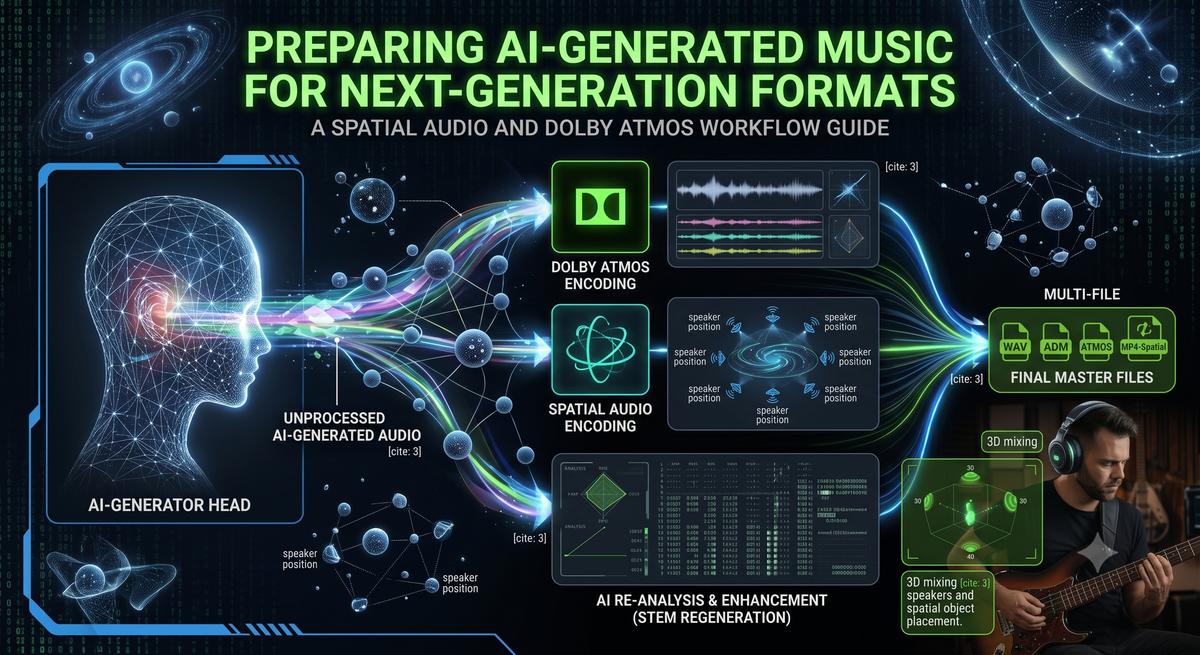
To understand why this shift presents a challenge for artificial intelligence music production, one must understand the difference between channel-based audio and object-based audio. Traditional surround sound formats, such as 5.1 or 7.1, are channel-based. The audio engineer routes specific instruments to specific physical speakers in a room. Dolby Atmos operates differently: it has a 7.1.2 channel bed foundation for static sounds, but its true power lies in its ability to designate up to 118 independent audio tracks as objects. Instead of sending an object to a specific speaker, the engineer assigns it three-dimensional spatial coordinates using metadata.
When the consumer plays the song, the Dolby Atmos rendering engine calculates exactly how to reproduce those coordinates based on the listener's specific playback system. If the listener has a home theater with twelve physical speakers, the renderer will utilize all of them to place the audio object precisely in the room. If the listener is using standard stereo headphones, the renderer will use advanced binaural algorithms to simulate the 3D space using only two channels.
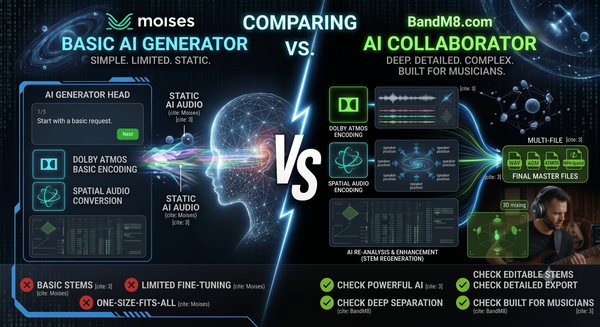
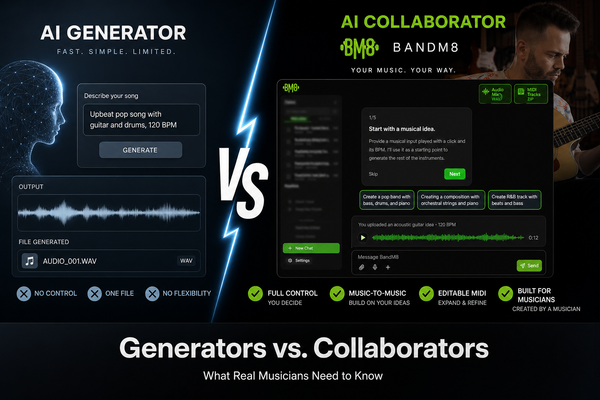
This new requirement for spatial mixing exposes a critical flaw in legacy artificial intelligence music generators. Many popular text-to-music platforms output a single, flattened stereo WAV file. All the instruments, the drums, the bass, the guitars, and the vocals, are permanently baked together into two channels. You cannot separate a mixed stereo file into the discrete audio objects required for a proper Dolby Atmos mix. While some software applications attempt to upmix stereo files into surround sound using phase manipulation and artificial reverberation, the results are generally poor. These artificial upmixes often suffer from severe phase cancellation, causing instruments to disappear when the mix is folded back down to standard stereo playback.
Platforms that prioritize MIDI generation, rather than audio generation, provide the exact isolation required for immersive mixing. BandM8 generates completely isolated, multi-track MIDI data for each individual instrument. Because MIDI contains performance instructions rather than recorded acoustic sound, there is absolutely zero bleed between the generated drum track and the generated bass track.
The producer exports the separated MIDI files from the music-to-music platform. They then import these files into an Atmos-capable digital audio workstation, such as Logic Pro, Pro Tools, or Nuendo. Because the tracks are completely isolated, the producer has total freedom to utilize object-based panning. They can route the AI-generated drum kit and bassline to the static bed channels, anchoring the rhythm section firmly in the front of the listening space. They can then take the AI-generated string section, designate it as an audio object, and map it to the height channels, creating a canopy of sound above the listener. They can even automate the panning metadata, taking an AI-generated synthesizer sequence and making it circle the listener's head in sync with the tempo of the song.
Streaming algorithms and editorial playlist curators are actively searching for content mixed in Dolby Atmos to showcase the capabilities of new consumer hardware, such as spatial audio headphones and smart speakers. Artists who can deliver spatial audio mixes have a distinct competitive advantage when pitching their music to streaming platforms and music supervisors. By utilizing MIDI-first artificial intelligence platforms they avoid the trap of being locked into flat, two-dimensional stereo files, ensuring their music meets the rigorous technical standards of the next generation of immersive audio distribution.