Why MIDI Export is the Holy Grail of AI Music Production

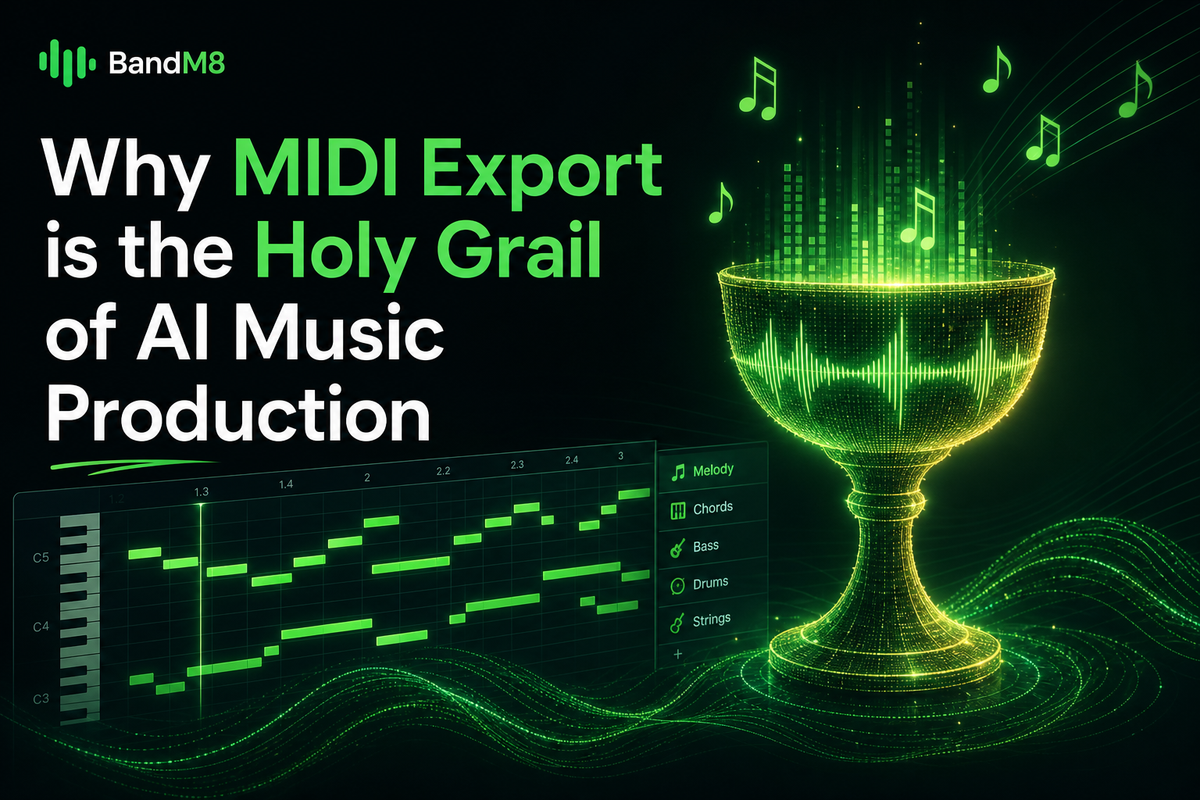
The Direct Answer: Why MIDI Export Matters
Why is MIDI export important for AI generated music? MIDI export is crucial because standard audio files (WAV/MP3) generated by AI are static and difficult to edit without degrading sound quality. MIDI, however, contains no actual audio—only performance data (notes, velocity, rhythm). Exporting AI-generated music as MIDI allows producers to completely alter the performance, fix wrong notes, and route the data through their own premium Virtual Studio Technology (VST) instruments for professional sound quality.
The Limitations of Static Audio Stems
If you’re producing music, you've likely heard of MIDI (Musical Instrument Digital Interface). It is a universal technical standard that allows electronic musical instruments, computers, and other audio devices to communicate with one another. But what makes it the absolute holy grail in the rapidly evolving age of AI audio? To understand this, we have to critically examine the severe limitations of standard audio files, and why professional producers universally demand full control over their mixes.
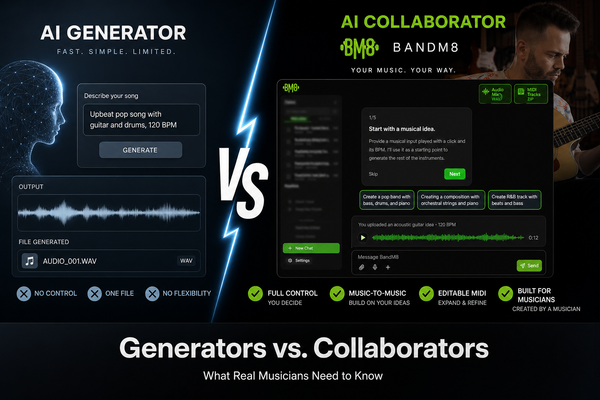
When a zero-shot AI generator creates an instrumental track and exports it as a standard WAV or MP3 file (or even as separated audio stems), you are receiving a static final mix. If the AI piano plays a wrong chord that clashes with your vocal, or if the digital drum kit sounds too synthetic for your organic indie-folk track, there is very little you can do to fix it. Correcting pitch, altering drum timbre, or changing chord voicings inside an audio file requires digital signal processing that inevitably degrades the sound quality with robotic artifacts.
The MIDI Advantage Explained
MIDI changes the game entirely. As a protocol, MIDI contains no actual sound whatsoever. Instead, it is a highly lightweight language that transmits performance instructions to a computer. It tells the software exactly which notes were played (Note-On/Note-Off), their rhythmic duration, and the velocity (how hard the keys were struck).
Instead of trapping you with uneditable, potentially cheap-sounding audio stems, an AI collaborator like BandM8 exports the AI's generated performance as raw, multi-track MIDI data.
Achieving Ultimate Creative Control via VST Integration
When you drag an AI-generated instrumental part as a MIDI file into your DAW (like Logic Pro, Ableton, or Cubase), you assume absolute sovereignty over the performance. You can physically grab a single out-of-key note and drag it onto the correct pitch. You can quantize the rhythm perfectly to the grid.
More importantly, you can route this MIDI performance through your own Virtual Studio Technology (VST) instruments. If the AI's default string section sounds thin, you can bypass it entirely and route the AI's MIDI data through a sampled orchestral library.