Audio-to-MIDI Conversion: Best Tools and Methods
Turning audio into editable MIDI is one of the most powerful workflows in modern production.
Audio-to-MIDI conversion takes a recorded audio signal and translates it into MIDI data: note values, velocities, timing, and duration. For producers and musicians, this means any recorded performance can become editable, rearrangeable, and endlessly flexible. BandM8 builds audio-to-MIDI conversion directly into its Music-to-Music AI pipeline, using it as the first step in generating full band arrangements from a musician's live performance. You play. BandM8 converts your audio to MIDI, analyzes the musical content, and generates new parts that complement what you played.
The technology has improved dramatically in the last two years. Early audio to MIDI converters struggled with polyphony, fast passages, and noisy recordings. Modern AI-powered converters handle complex chords, multiple simultaneous voices, and imperfect recordings with far greater accuracy. For any musician working in a DAW, understanding audio-to-MIDI conversion is now essential.
This guide covers how the technology works, where it fits in a modern production workflow, what the best tools and approaches are, and how BandM8 uses audio-to-MIDI as the foundation for a completely new way of making music with AI.
How Audio-to-MIDI Conversion Works
The conversion process starts with pitch detection. The algorithm analyzes the audio signal to identify which notes are being played, when they start and stop, and how loud they are. Monophonic conversion, where only one note sounds at a time, is relatively straightforward. The real challenge is polyphonic conversion, where multiple notes overlap, as in a strummed guitar chord or a piano passage with sustained pedal.
AI-powered converters use neural networks trained on large datasets of paired audio and MIDI music to improve accuracy. These models learn to separate overlapping pitches, identify instrument timbres, and handle the transient noise that confuses simpler algorithms. The result is MIDI data that faithfully represents what was actually played, not a rough approximation that needs heavy editing.
The accuracy improvements over the past two years have been substantial. Older algorithms relied on spectral analysis and heuristic rules to guess at pitches. They worked reasonably well for clean, monophonic sources like a solo flute or a single vocal line, but fell apart when confronted with real-world recordings: a guitar with string noise, a piano with pedal bleed, a vocalist with vibrato. Modern neural network approaches handle these scenarios because they have learned from millions of examples what real performances sound like, including all the imperfections and complexity that make music human.
Beyond pitch detection, advanced converters also capture velocity information, which corresponds to how hard a note was played. This is critical for maintaining the feel of a performance. A piano passage where every note is the same velocity sounds robotic. A converted passage that preserves the original dynamics sounds like it was played by a person, because it was. The best audio-to-MIDI tools preserve this nuance, and BandM8's conversion layer is specifically optimized for it because dynamic information directly affects the quality of the AI-generated accompaniment.
Audio-to-MIDI in BandM8's Architecture
BandM8 uses audio-to-MIDI as the input layer of its MIDI-first AI system. When you play into the platform, your audio is immediately converted into MIDI. That MIDI data is then analyzed for key, tempo, rhythm, and harmonic content. The analysis feeds BandM8's generation models, which produce new multi-track MIDI parts for additional instruments. The entire chain runs in real time.
This architecture means you never need to think about audio-to-MIDI as a separate step. You play guitar, and BandM8 delivers drums, bass, and keys. The conversion happens invisibly, as part of the listening process. But the fact that MIDI sits at the core of the pipeline is what makes everything else possible: the editability, the instrument flexibility, and the seamless DAW export.
The real-time requirement is what makes BandM8's audio-to-MIDI implementation different from standalone conversion tools. When you are using a dedicated converter, you typically process a finished recording and then review the MIDI output at your leisure. In BandM8, the conversion has to happen fast enough that the AI can respond musically while you are still playing. Latency in this context is not just a technical metric. It is a musical one. If the AI's response comes even a beat late, the experience of playing with a band falls apart. BandM8's audio-to-MIDI layer is optimized specifically for the low-latency demands of live collaboration.
Standalone Audio-to-MIDI Tools Worth Knowing
Outside of BandM8's integrated workflow, several standalone tools handle audio-to-MIDI conversion well. Most major DAWs now include built-in conversion features. Ableton Live's audio-to-MIDI function works for drums, melody, and harmony separately. Logic Pro offers Flex Pitch, which can export detected pitches as MIDI. Dedicated third-party plugins and apps focus on specific use cases, from guitar transcription to full polyphonic piano conversion.
The standalone approach is useful when you need to transcribe a specific recording or extract a part from an existing track. But it is a single-step tool: you get MIDI from audio, and then you do something with it manually. BandM8's approach differs because audio-to-MIDI is not the end of the workflow. It is the beginning. The conversion feeds directly into arrangement generation, so you move from raw audio to a full band in one creative pass.
Each standalone tool has strengths in specific contexts. Ableton's drum conversion is particularly strong because drum hits have clear transients that are easier to detect than sustained pitched notes. Logic's Flex Pitch excels with monophonic vocal and instrument lines. Third-party tools like Melodyne offer surgical pitch-level editing after conversion, which is valuable for fixing individual notes in a transcription. The choice depends on what you need the MIDI for.
For producers who work across multiple DAWs or who need to convert audio for purposes beyond BandM8's collaborative workflow, having standalone conversion tools in your toolkit is still valuable. The key insight is understanding that audio-to-MIDI conversion is not one problem but several. Converting a solo violin is different from converting a distorted guitar. Converting a drum kit is different from converting a choir. The best results come from choosing the right tool for the specific source material and the specific purpose you have in mind.
Common Challenges and How AI Solves Them
The hardest problems in audio-to-MIDI conversion are polyphonic detection, noise handling, and timing accuracy. Polyphonic detection requires the algorithm to identify multiple simultaneous notes from a single audio stream. This is analogous to hearing a conversation in a crowded room and correctly attributing every word to the right speaker. AI models solve this through learned representations of how instruments produce overlapping sounds, allowing them to untangle complex harmonic content that rule-based algorithms cannot parse.
Noise handling matters for real-world recordings. A guitar recording includes string squeaks, fret buzz, and room ambiance alongside the musical notes. A vocal recording includes breaths, mouth sounds, and room reflections. AI converters learn to distinguish between intentional musical content and incidental noise, producing cleaner MIDI output from imperfect sources. This tolerance for imperfection is what makes modern audio-to-MIDI practical for musicians who record in bedrooms and home studios rather than treated recording environments.
Timing accuracy is the third major challenge. Human musicians do not play perfectly on the grid. They push ahead of the beat, drag behind it, and fluctuate in ways that create groove and feel. A converter that snaps everything to the nearest sixteenth note loses the humanity of the performance. The best AI converters preserve these micro-timing variations, and BandM8's converter is specifically tuned to retain them because they are essential input for the AI accompaniment engine. A stiff, quantized representation of your playing would produce stiff, quantized accompaniment. A nuanced representation produces accompaniment that breathes with you.
Audio-to-MIDI for Different Instruments
The effectiveness of audio-to-MIDI conversion varies significantly depending on the source instrument. Monophonic instruments like trumpet, flute, and solo voice convert with the highest accuracy because there is only one pitch to track at any given time. The algorithm's job is straightforward: identify the pitch, track it as it changes, and record the timing of each note onset and offset.
Polyphonic instruments like piano and guitar present a much harder challenge. A single guitar strum can contain six simultaneous notes, each with its own attack, sustain, and decay characteristics. A piano chord with sustained pedal can contain overlapping harmonics from multiple notes that blend together acoustically. AI converters handle these scenarios by learning the spectral signatures of different interval combinations and chord voicings, allowing them to untangle the overlapping frequencies more accurately than rule-based algorithms.
Drums present a unique case because they are pitched but not in the traditional sense. A kick drum, snare, and hi-hat each occupy different frequency ranges, and the converter needs to identify which drum was hit, when, and how hard. AI models trained specifically on drum audio perform this task well because they learn the characteristic transient shapes and spectral profiles of different percussion instruments. The MIDI output maps each hit to the appropriate note value on a standard drum map, ready for use with any drum plugin.
For BandM8 users, the practical implication is that you can play any instrument into the platform and the audio-to-MIDI conversion layer will translate it into data the AI can work with. Guitar, keyboard, bass, voice, drums, or any other acoustic or electric instrument. The conversion quality varies by instrument complexity, but the AI generation engine is designed to work effectively with the data it receives, even if the conversion is not note-perfect. A few missed notes in the conversion do not derail the arrangement because the AI is reading patterns and tendencies, not individual pitches in isolation.
The Future of Audio-to-MIDI Technology
Audio-to-MIDI conversion is improving rapidly, driven by advances in neural network architecture and the availability of larger, higher-quality training datasets. The next generation of converters will handle increasingly complex sources: full mixes, live ensemble recordings, and degraded audio from vintage recordings. These capabilities will open new creative possibilities for producers who want to extract musical ideas from any audio source and work with them as editable MIDI.
For BandM8, improvements in audio-to-MIDI directly translate to better AI accompaniment. The more accurately the platform can read your performance, the more musically appropriate its response will be. A converter that captures the subtle difference between a hard-strummed chord and a gentle arpeggio gives the AI more information to base its response on, which produces accompaniment that matches not just the notes you played but the way you played them. This is the difference between an AI that follows your harmony and an AI that follows your expression.
The long-term vision is seamless translation between the physical and digital domains. You play your instrument. The music enters the digital realm as perfectly represented MIDI data. The AI responds. The response enters the physical realm as sound through your speakers or headphones. The entire loop feels like playing with a band in a room because the translation in both directions is fast enough and accurate enough that the technology becomes invisible. BandM8 is building toward that vision, and audio-to-MIDI conversion is the critical first link in the chain.
Why MIDI Output Matters More Than Audio Output
MIDI gives you the music. Audio gives you the recording. Producers need both, but they need MIDI first.
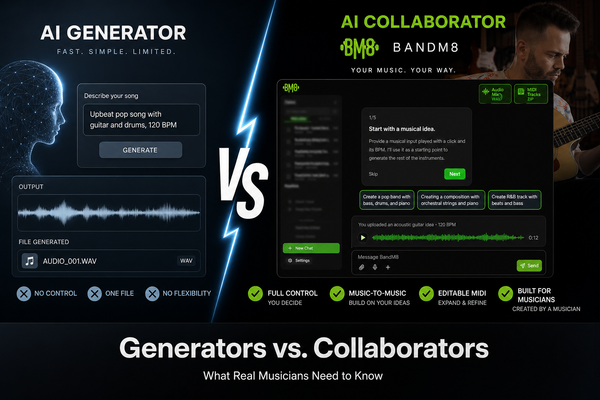
AI music tools that output rendered audio give you a finished product. You can use it or discard it, but you cannot meaningfully reshape it. Tools built on MIDI generation give you musical raw material. Every note, every velocity, every timing value is accessible and editable. For serious music producers, this is the difference between a tool that makes decisions for you and a tool that gives you options.
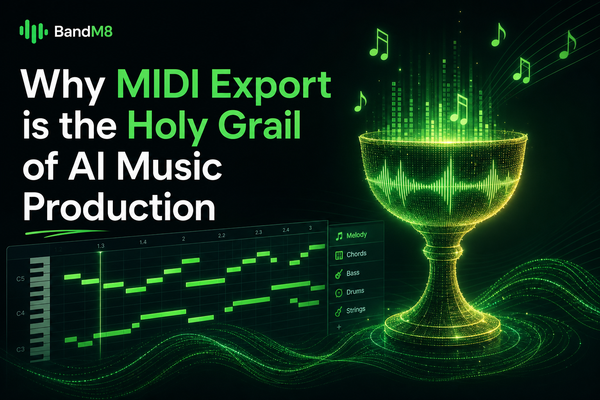
The practical implications are significant. A MIDI bass line can be transposed, re-voiced, or completely rewritten in a piano roll. An audio bass line can only be time-stretched, pitch-shifted, or replaced entirely. MIDI drums can have individual hits moved, velocities adjusted, and patterns restructured note by note. Audio drums are a fixed recording. The creative control that MIDI provides is not a subtle advantage. It is the difference between being a producer and being a consumer of generated content.
Audio-to-MIDI conversion is the bridge between the physical act of playing and the digital flexibility of MIDI production. BandM8 builds that bridge into every interaction with the platform. You play in audio. You work in MIDI. You export whatever format your project needs. The conversion is not a feature. It is the foundation that makes collaborative AI music possible.
The relationship between audio-to-MIDI accuracy and production quality is not linear. There is a threshold of accuracy below which the MIDI data is not useful, and above which additional accuracy yields diminishing returns. Most modern AI converters, including the one BandM8 uses, operate well above that threshold for typical use cases. A few missed notes in a complex polyphonic passage do not materially affect the quality of the AI-generated accompaniment because the overall harmonic and rhythmic picture is still accurate. Producers who obsess over note-perfect conversion are often solving a problem that does not exist in practice. What matters is whether the conversion captures enough musical information to inform a good arrangement, and in the vast majority of cases, it does.
For producers and musicians, audio-to-MIDI conversion has evolved from a niche technical tool to a foundational creative technology. It is the bridge between the analog world of human performance and the digital world of MIDI-based production. BandM8 builds that bridge into the core of its platform because without it, the Music-to-Music AI paradigm does not work. The conversion enables everything else: the harmonic analysis, the arrangement generation, the multi-track output, and the seamless DAW integration that makes BandM8 practical for professional production workflows. Understanding how it works helps you understand why the platform produces the results it does, and why those results start with the most important thing in music: your performance.
Play something. BandM8 builds the band.
Try BandM8 free and hear what happens when AI plays with you.
Get Started