BandM8 vs Suno vs Udio: A Different Kind of Music Tool

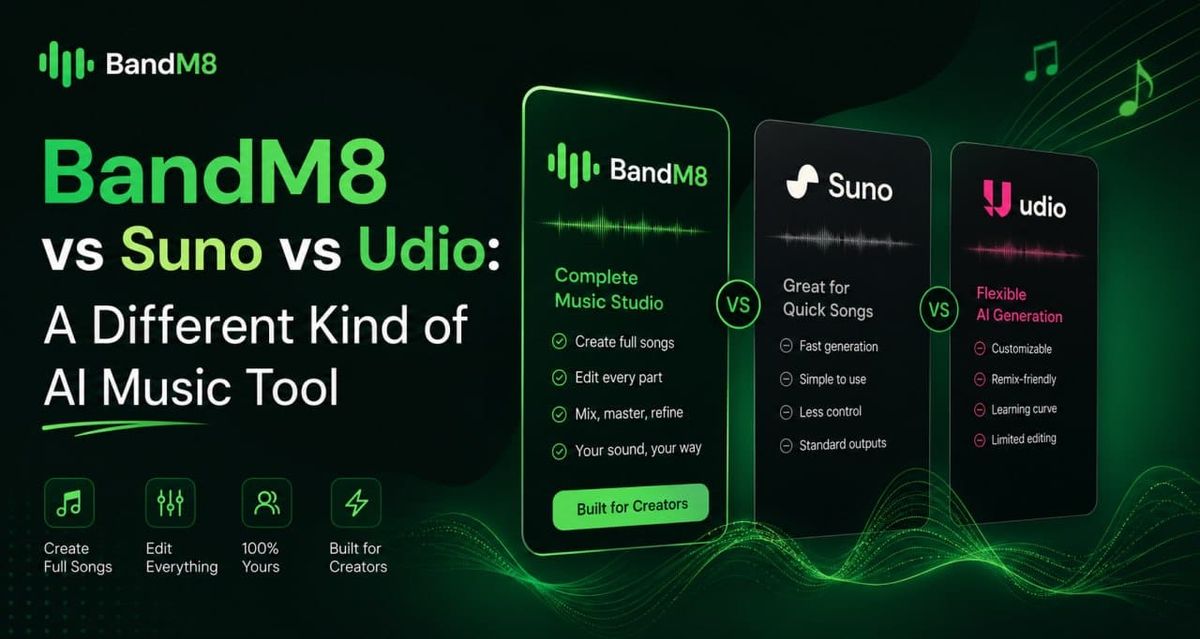
Three platforms. Three philosophies. Only one of them starts with a musician.
When musicians search for AI music tools in 2026, they encounter a landscape that looks more unified than it is. The category label — AI music — gets applied to platforms that are doing fundamentally different things, serving fundamentally different audiences, and operating on fundamentally different values. Comparing BandM8 to Suno AI and Udio requires understanding not just what each platform produces, but what each platform believes music creation is for and who it is designed to serve.
The differences are not subtle. They run from the input each platform requires, through the output each platform delivers, all the way to the legal and ethical foundations each platform was built on. A musician choosing between these tools is not choosing between versions of the same thing. They are choosing between entirely different philosophies about what AI music should be.
Where Each Platform Starts
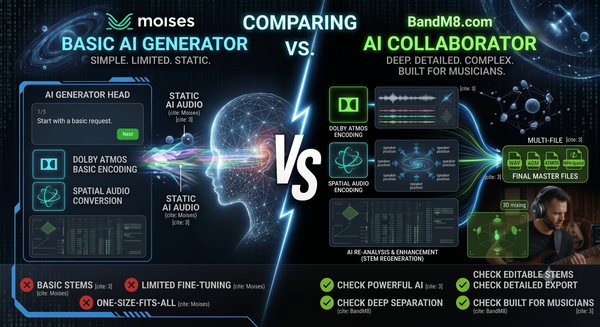
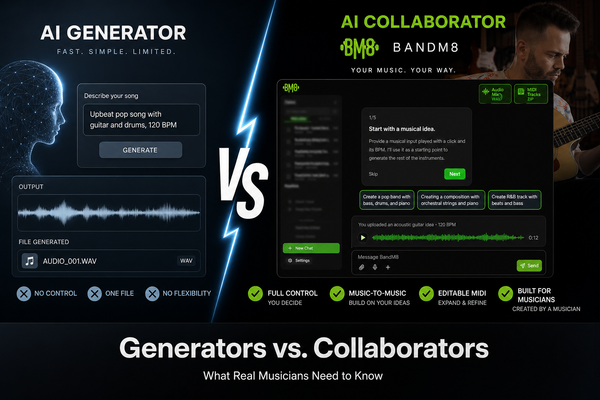
The most fundamental difference between BandM8 and its competitors is the input. Suno and Udio are both text-to-music platforms. The musician — or more accurately, the user, since playing an instrument is not required — types a description of the music they want. A genre, a mood, a reference artist, a vibe. The platform processes that text prompt and generates audio. The user does not need to play anything. They do not need to know anything about music theory, rhythm, or harmony. They just need to describe what they want in words.
BandM8 is a Music-to-Music AI platform. The input is always musical. A musician plays their instrument — guitar, piano, bass, keys, anything with a clear pitch signal — and BandM8 analyzes that performance to generate a full multi-track accompaniment built specifically around what was played. There is no text prompt at the center of the process. There is a musician. The AI's job is to respond to what that musician creates, not to generate something independent of it.
This difference shapes everything downstream. Who the platform is for, what the output looks like, who owns it, and what legal standing it has are all direct consequences of where the creative process begins.
What Each Platform Produces
Suno produces complete songs. You submit a text prompt and receive a fully produced audio track — vocals, instrumentation, production, all baked into a single audio file. The quality, by 2026, is genuinely impressive for what it is. The vocals sound human. The production is polished. For someone who wants a finished-sounding track quickly and has no interest in editing or production work, Suno delivers a compelling result.
Udio operates similarly, with a focus on pop and EDM styles and more granular control over certain generation parameters. Following its 2025 settlement with Universal Music Group and Warner Music Group, Udio has repositioned as a licensed remixing and fan engagement platform — its output model has shifted significantly from where it started, and its users now operate under restrictions that limit how generated content can be downloaded and used.
BandM8 produces multi-track MIDI. Not a finished audio file. Not a single mixed track. Individual instrument stems — drums, bass, keys, guitar parts — each delivered as separate, fully editable MIDI files that the musician can take into any DAW and work with exactly as they would work with any other recorded part. The output is a creative foundation, not a finished product. The musician decides when it is done.
The Editability Gap
For working musicians, the difference between a fixed audio output and an editable MIDI output is the difference between a suggestion and a tool. Suno and Udio give you something to listen to. BandM8 gives you something to work with.
When a Suno track is not quite right — when the drum feel is slightly off, when the key does not match the rest of the project, when the bass line goes in a direction the musician did not want — the options are limited. Regenerate and hope. Accept the compromise. Or spend significant time on audio manipulation — pitch shifting, time stretching, stem separation — just to make the output fit into an actual production workflow. None of these are solutions a professional musician finds satisfying.
With BandM8's MIDI-first output, every element of the generated arrangement is immediately editable. The drummer plays a fill the musician does not want — delete it. The piano voicing sits in the wrong register — transpose it. The bass line is too busy — reduce the note density directly in BandM8 or open the MIDI file and edit it manually. The DAW integration is seamless because MIDI is the native language of every professional production environment. No conversion, no workaround, no compromise.
Suno and Udio are content tools. BandM8 is a musician's tool. The difference is not cosmetic.
Who Each Platform Is Actually For
Suno and Udio are genuinely useful for a specific audience: content creators, social media producers, hobbyists, and anyone who needs music quickly and does not have a production workflow to integrate it into. A YouTuber who needs background music for a video, a podcaster who needs an original intro track, a social media creator who wants a custom sound for a reel — these are real use cases, and text-to-music platforms serve them well. The output does not need to be professionally editable. It just needs to sound good and be available fast.
BandM8 is built for a different audience entirely. The independent artist who writes songs on guitar and needs to hear what a full band arrangement sounds like before deciding whether the chord progression is working. The bedroom producer who has been building tracks alone for years and wants an intelligent collaborator who responds to their actual playing. The solo musician who needs to demo a full arrangement for a label meeting but does not have a band available. The DAW-native creator who wants to accelerate their existing workflow without replacing it.
These musicians do not need a finished product generated from a text prompt. They need a responsive, intelligent collaborator who can build around what they are already creating — and deliver the output in a format they can actually use professionally. BandM8 is built for that need specifically.
The Training Data Divide
The legal history of Suno and Udio is now well documented. Both platforms were sued by the major labels in 2024 for training their models on copyrighted recordings without consent. Both reached settlements in 2025 that required them to retrain their models on licensed data only and implement structural restrictions on how outputs can be used. The platforms that musicians used in 2023 and 2024 are legally and technically different from the platforms that exist in 2026 — and the restrictions that came with those settlements have meaningfully changed what users can do with the output.
BandM8 has no equivalent history because it has no equivalent exposure. BandM8 uses licensed MIDI training exclusively. Its no-scraping policy is a foundational architectural decision, not a response to legal pressure. The model was built on data that was handled correctly from the start, which means there is no pending legal uncertainty about the status of its training data, no settlement terms that might further restrict its capabilities, and no ongoing litigation that musicians need to factor into their decision about whether to build a workflow around the platform.
Copyright-safe AI music is not just an ethical preference — it is a practical advantage in a market where the legal ground has shifted repeatedly under the dominant platforms. Musicians who need to license, distribute, or commercially release what they create need to know that the tool they used to create it is not going to create legal complications downstream. BandM8 offers that certainty. Its competitors are still working toward it.
Creator Ownership: The Real Comparison
Creator ownership is where the comparison between these platforms becomes most practically significant for musicians who want to release and monetize what they make. The question is simple: when you finish a track, who owns it?
On Suno and Udio, the answer has historically been complicated by terms of service that grant the platforms broad licenses to user-generated content, and by the legal uncertainty surrounding whether AI-generated audio has the same copyright protection as human-created music. The settlement terms have added additional layers of restriction — in some cases limiting how outputs can be downloaded, in others requiring attribution or imposing commercial use restrictions depending on subscription tier.
On BandM8, the musician owns the output. The platform has no claim on what musicians create. There is no underlying license granted back to BandM8. There are no tier-based restrictions on commercial use. The track a musician builds from their own performance, directed by their own creative decisions, belongs to them completely — for release, for sync licensing, for commercial distribution, for anything they choose to do with it. The AI contributed skill. The AI music rights stay with the creator.
Conversational Control vs Prompt Generation
One dimension of the comparison that matters specifically to working musicians is how each platform handles adjustments after the initial generation. On text-to-music platforms, the primary mode of refinement is regeneration — submit a new or modified prompt and receive a different output. This is fast, but it is not precise. If a musician loves 80 percent of what a Suno track produced but wants a completely different drum feel, they cannot surgically change just the drums. They submit a new prompt and get an entirely new track, which may fix the drum problem but introduce new issues elsewhere.
BandM8's conversational music control works differently. Because the output is multi-track MIDI, adjustments can be applied to specific instruments without affecting the rest of the arrangement. A musician who loves the bass line and the keys but wants different drums can direct BandM8 to rebuild just the drum track while leaving everything else intact. The Music Prompt system translates natural language direction — "make the hi-hats more open" or "simplify the kick pattern" — into specific MIDI changes on the relevant track only.
This level of targeted control is only possible because of the MIDI-first architecture. It is not a feature that can be retrofitted onto a fixed audio output system. It is a consequence of building the platform around editable, multi-track output from the start.
The Right Tool for the Right Job
The honest conclusion from this comparison is not that Suno and Udio are bad tools — it is that they are tools for a different job. If a content creator needs background music for a video in the next twenty minutes and has no interest in production workflow, Suno is a genuinely efficient solution. If a social media producer wants to generate a large volume of varied musical content quickly, Udio's interface offers real utility for that specific use case.
But if a musician wants to build something real — something they can release, something that reflects their actual playing, something they can take into a professional production environment and finish on their own terms — BandM8 is the only platform in this comparison that was built for that purpose. The AI bandmate model is not a variation on the text-to-music model. It is a different category entirely, built on a different set of values, for a different kind of creator.
In 2026, musicians have enough information to make this distinction clearly. The legal history of text-to-music platforms, the restrictions that have followed from it, and the fundamental question of what kind of creative tool a musician actually needs — all of it points toward the same conclusion. Ethical AI music built around a real musician's input is not a niche offering. It is the direction the industry needs to move. BandM8 is already there.
Play something. BandM8 builds the band.
Try BandM8 free and hear what happens when AI plays with you.
Get Started