What Is Music-to-Music Music Generation?

A new category of music creation tool is emerging. It does not start with words. It starts with a musician.
Most conversations about AI music begin with text. You type a description, choose a mood, pick a genre, and the system generates something. The result is audio you can listen to but cannot easily change, built from a prompt written by someone who may not play a single instrument. That is the model that has dominated AI music since 2023. It is also the model that the music industry has fought hardest against — and for good reason.
Music-to-Music AI is different. It is a category of AI music tool where the input is always musical — a live instrument, an audio clip, a MIDI file — and the output is always editable, professional-grade MIDI that the musician controls, adjusts, and owns. There is no text prompt at the center. There is a player. The AI listens, responds, and builds around what that player creates. BandM8 is the first platform built entirely on this model.
Understanding what makes this category distinct — and why it matters — requires understanding what has been missing from every AI music tool that came before it.
The Problem With Text-First AI Music
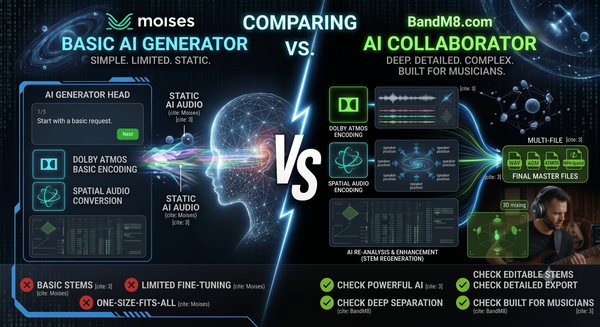
When Suno AI and Udio emerged as the dominant forces in AI music generation, they demonstrated something remarkable: a machine could produce a complete song from a written description in under a minute. The quality, by certain measures, was impressive. The songs had structure. The vocals sounded human. The production was polished. For casual listeners, the results were often surprising.
But for working musicians, the tools solved the wrong problem. Songwriters do not struggle to describe music in words. They struggle to hear what a fully arranged version of their idea sounds like before they have the time, money, or collaborators to build it. Producers do not need a machine to invent something from scratch. They need a responsive system that extends and develops what they are already creating. The text-to-music model was built for content creators and non-musicians. It was not built for players.
There is another problem. The audio that text-to-music systems produce is fixed. You can listen to it. You can use it as-is. But if you want to change the drum pattern, adjust the bass line, or swap the key — you are starting over. The output is a finished product, not a creative foundation. For a professional musician, that is not a tool. It is a dead end.
Music-to-Music AI was built to solve exactly this. The output is never fixed. It is always editable. It is always yours.
How Music-to-Music AI Actually Works
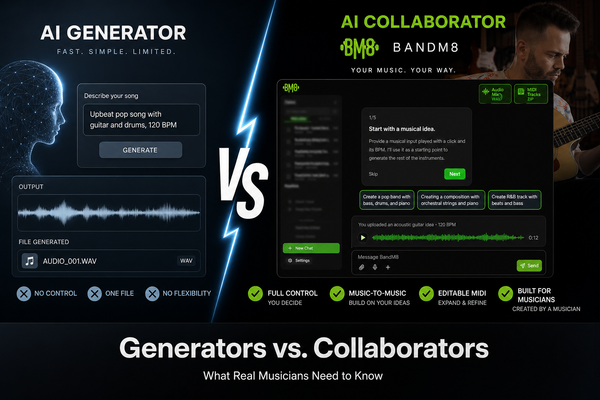
The core mechanic is straightforward. A musician plays their instrument — guitar, piano, bass, anything — and records a short clip or plays live into the system. The AI analyzes that input in real time, identifying the key, the tempo, the harmonic content, and the rhythmic feel. It then generates a full multi-track accompaniment — drums, bass, keys, additional melodic parts — that responds to what the musician actually played, not to a written description of what they wanted to play.
This distinction is everything. Real-time accompaniment generated from a live musical input is fundamentally different from audio generated from a text prompt. One responds to your actual performance. The other responds to your description of a performance. The gap between those two things is the gap between a collaborator and a content machine.
BandM8's system handles key detection automatically. Musicians only need to provide genre and BPM. From there, the platform builds the band. The output is multi-track MIDI — not a single audio file, but individual instrument stems that the musician can take into any DAW, edit note by note, rearrange, layer, and mix exactly as they want. The creative ownership stays with the player from the first note to the final export.
The input is always musical. The output is always editable. The musician is always in control.
Why MIDI Changes Everything
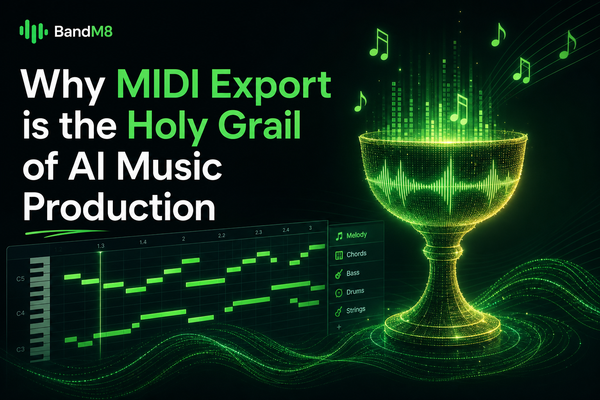
The choice to build around MIDI-first output is not a technical detail. It is a philosophical one. MIDI is the language of professional music production. It is what every major DAW runs on. It is what session musicians record into, what producers arrange with, what engineers mix from. When BandM8 generates MIDI, it generates something a professional can actually use — not a static audio file they have to work around.
MIDI generation also means the output is infinitely adjustable. If the drums feel too busy, pull back the note density. If the piano part needs more movement, increase the polyphony. If a single section needs to be completely rebuilt, open the MIDI file in your DAW and change it. Nothing is locked. Nothing is final until the musician decides it is.
This is what separates Music-to-Music AI from every other category in the AI music space. Text-to-music tools generate finished products. Music-to-Music AI generates creative raw material — professional-grade, fully editable, built from your actual performance. The difference in workflow is enormous. The difference in creative ownership is even larger.
The Role of Conversational Control
One of the most significant features of Music-to-Music AI is how musicians interact with the system after the initial generation. BandM8 uses conversational music control — natural language direction that adjusts the output without requiring the musician to touch a single technical parameter.
Instead of opening a MIDI editor to reduce the velocity of a hi-hat pattern, a musician can say "make the drums feel lighter." Instead of manually adjusting note spacing on a keyboard part, they can say "make the piano busier in the chorus." The system interprets the musical intent behind the instruction and applies it. This is not a gimmick. It is a fundamental rethinking of how humans and AI interact in a music production context.
The Music Prompt model replaces technical friction with musical conversation. A musician does not need to know what a MIDI velocity curve is to get the feel they want. They just need to describe it the way they would describe it to a bandmate. That accessibility — without sacrificing professional-grade output — is what makes this category genuinely new.
Who Music-to-Music AI Is Built For
The short answer: anyone who plays an instrument and wants to hear what a full band sounds like around their idea. The longer answer covers a wide range of working musicians.
The bedroom producer who has been building tracks alone for years and never had access to live session musicians. The solo musician who writes on guitar but struggles to demo a full arrangement before bringing it to a band. The independent artist who needs to produce professional-quality tracks without a studio budget. The songwriter who wants to hear the verse with a full rhythm section before deciding whether the chord progression is working.
Music-to-Music AI is also built for the DAW-native creator who already has a professional workflow and wants to accelerate it — not replace it. BandM8's MIDI output drops directly into Ableton, Logic, FL Studio, or any other production environment. The platform is not asking musicians to change how they work. It is adding a responsive, intelligent collaborator to the workflow they already have.
Why This Category Matters in 2026
The AI music industry in 2026 is at a crossroads. The dominant text-to-music platforms have faced legal challenges, copyright disputes, and growing backlash from artists and rights holders. Suno and Udio have both entered settlement agreements with major labels that fundamentally restrict how their models are trained and how their outputs can be used. The Bandcamp AI ban has signaled that platforms built on automated, musician-free generation are not welcome everywhere.
Into this environment, Music-to-Music AI offers a different path. Because BandM8 trains on licensed MIDI and requires a real musician at the center of every creation, it sidesteps the ethical and legal problems that have plagued text-to-music tools entirely. There is no question of whether the output belongs to the musician — it does, because the musician created the input that drove everything. There is no question of whether the training data was authorized — it was, because BandM8 does not scrape and does not generate without a human player in the loop.
Ethical AI music is not a marketing position for BandM8. It is a structural consequence of how the platform was built. When the input is always musical and the musician always drives the process, the ethical questions that have destabilized the rest of the industry simply do not arise.
The Platform Behind the Category
BandM8 is built on NVIDIA Nemotron, giving it the infrastructure to process musical input and generate multi-track output with the low latency that real-time performance demands. The platform runs entirely in a browser — no downloads, no DAW required to get started, no setup that gets between the musician and the music.
The founding team behind BandM8 comes from deep inside the music industry. The platform's creator-first philosophy is not incidental — it reflects decades of experience working directly with artists, understanding what they need, and building systems that protect rather than exploit their work. That background shapes every product decision, from the choice to output MIDI instead of audio to the decision to make creator ownership non-negotiable from day one.
Music-to-Music AI is not the future of AI music. It is the present — available now, built for working musicians, and designed to make the full-band sound accessible to anyone who can play an instrument. The category is new. The tools are real. And the gap between inspiration and execution has never been smaller.
Play something. BandM8 builds the band.
Try BandM8 free and hear what happens when AI plays with you.
Get Started